How to Offer AI-Visibility Audits as an Agency Service (2026 Playbook)
A step-by-step playbook for launching AI-visibility audits as an agency service line in 2026, covering tool selection, pricing, pitching, objection handling, and deliverable templates.
By Josiah Jirgens, Technical Director of ComKey Consulting
In 2026, every SEO and marketing agency is getting the same question from clients: "Am I showing up in ChatGPT?" Most agencies either fumble the answer or pivot to a generic "we're working on it." The ones who have a concrete offer, a productised AI-visibility audit with clear pricing, deliverables, and next steps, are winning the conversation and the retainer upgrade.
This is the operational playbook for launching AI-visibility audits as a service line. Not the strategic why (you've already decided to). This is the 6-step sequence to have your first paid audit delivered within 30 days. For the wider context, what AI visibility is, how AEO and GEO fit in, and where this service sits, see the AI visibility for agencies hub.
Why this is the service-line opportunity of 2026
Three dynamics make AI-visibility audits an unusually strong launch right now.
- Client demand is up, competitor supply is down. Almost every client is asking about it. Very few agencies have a structured offer.
- The tools are mature enough to deliver quickly. Doing this manually would take hours per client. Modern tools generate the audit in under a minute.
- The positioning halo is worth more than the delivery margin. Agencies that offer this look modern. Agencies that don't look like 2023.
This window will close by end of 2026 (every agency will offer it eventually). Early launchers get the positioning advantage.
The 6-step playbook
Step 1: Pick your audit tool
You have three options.
Option A: Build it yourself
Query ChatGPT, Perplexity, and Claude via API, parse citations, extract brand mentions. Technically doable. Operationally insane unless you're an engineering-heavy agency. 40+ hours of dev time for a tool you'll spend more hours maintaining.
Option B: Use a general SEO platform's AI-visibility bolt-on
Most major SEO platforms added something AI-ish in 2025. The depth varies wildly. Most are a keyword-position check against ChatGPT, not actual citation tracking.
Option C: Use a purpose-built AI-visibility audit tool
Tools designed for this specific job. Pricing is usually per-audit or flat monthly, with white-label branding included on agency plans.
The pragmatic choice for most agencies is Option C. Recommended: ConvertHook. Purpose-built for agency use: your logo on reports and verification emails, and (critically) your booking calendar embedded inside the report itself, so prospects can book a call when they see their competitive gap rather than three days later after they've cooled off. You can run your own domain through it right now:
Try ConvertHook on your own domain
See exactly how a brand appears in ChatGPT & AI search. Free audit, no credit card.
Step 2: Decide your service model
Three viable models for AI-visibility audits, in increasing order of commitment.
Model 1: Lead-magnet audit
What it is: free audit, offered publicly on your agency site. Visitors submit domain and email, get a branded report, and join your nurture sequence.
Best for: new client acquisition. Converts site visitors into pipeline.
Pricing: free to the visitor. Cost to you: a few dollars per audit generated.
Model 2: One-time paid audit
What it is: a paid deliverable you sell to existing clients and prospects. Typically includes the raw audit plus a 30-minute strategy call walking through findings.
Best for: upsell to existing clients, conversion offer for prospects.
Pricing benchmark: $500–$1,500 depending on client size. At the high end, bundle 2–3 follow-up calls.
Model 3: Ongoing AI-visibility retainer
What it is: monthly service tracking the client's AI visibility, quarterly optimisation work, and monthly reports.
Best for: existing retainer clients who want the visibility layer integrated with their SEO work.
Pricing benchmark: $500–$2,000/month as an add-on to existing SEO retainers. Standalone pricing tends to be $1,500–$5,000/month.
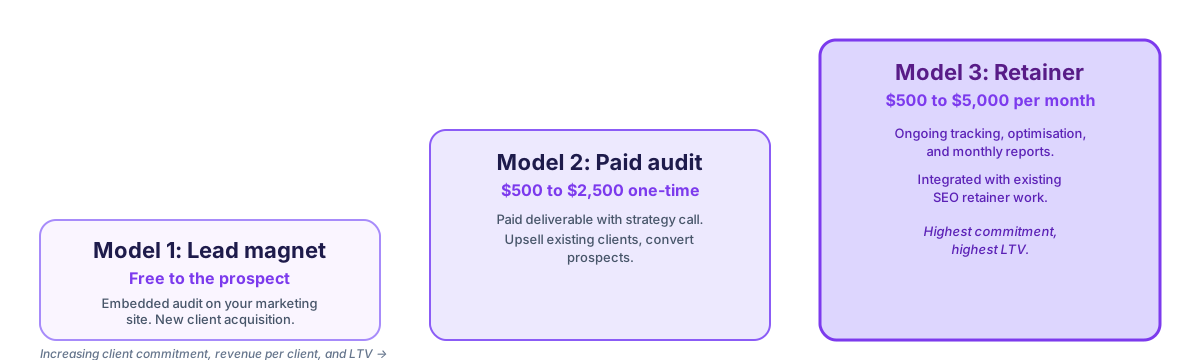
Most agencies start with Model 1 (lead magnet) and add Model 2 (paid audit) within 30 days. Model 3 (retainer) makes sense once you have 3+ paid audits delivered and understand the ongoing workload.
Step 3: Price it
Two common pricing mistakes to avoid.
- Pricing per audit when the work is mostly interpretation. Charge for the strategic output, not the tool run.
- Pricing too low because the tool makes delivery fast. Clients don't pay for your hours. They pay for the outcome and expertise.
Pricing benchmarks for 2026 (rough):
| Client type | One-time audit | Ongoing retainer (monthly) |
|---|---|---|
| Local or small business | $500–$1,000 | $300–$500 |
| Mid-market or growing brand | $1,000–$2,500 | $700–$1,500 |
| Established or enterprise | $2,500–$7,500 | $1,500–$5,000 |
For reference: the tool cost to generate an audit typically runs under $5. The rest is your expertise layer.
Step 4: Build the pitch
Two versions needed: one for existing clients (cross-sell), one for prospects (standalone offer).
For existing clients
"We're noticing that more of your competitors are getting cited in ChatGPT and AI search results than you are, which is starting to matter because [proof point]. I'd like to run an AI-visibility audit for you. It shows exactly where you're appearing, where you're not, and what we can do to close the gap. I'll have a full report back to you within [timeframe]."
Lead with the competitive gap, not the technology. Clients respond to "you're losing to competitors X, Y, Z" more than to "AI search is interesting."
For prospects
"We run a free AI-visibility audit on your domain. You'll see in 60 seconds exactly how your brand appears (or doesn't) in ChatGPT and AI search, and how you compare to your top 5 competitors. If the gap concerns you, we can talk about a path to close it."
Lead with the report, not the retainer pitch. Let the findings do the selling.
Step 5: Deliver the first audit
Your first audit delivery is the template for every one that follows. Invest in making it good.
The audit report itself (typically auto-generated by your tool)
Covers: visibility rate across major AI search surfaces, competitor comparison, citation sources, and domain presence by query.
The strategy layer (what you add on top)
Clients pay for this part. Add:
- An executive summary. Three sentences, in plain language, written by you rather than the tool.
- Top 3 findings, ranked by commercial impact rather than technical severity.
- Recommended actions, specific and prioritised, with rough effort estimates.
- The ask. What engagement would look like to address the findings.
The delivery call (30–60 minutes)
Walk through the report. Answer objections. Propose next steps. Schedule the follow-up before the call ends.
Step 6: Convert audits into retainers
The failure mode for agencies running audits is stopping at the audit. Audit delivered, invoice sent, move on. The retention play is different.
The conversion sequence:
- During the delivery call, propose a specific next step. Not "let us know when you're ready" but "we'd recommend Phase 1 over the next 60 days to close gaps 1, 2, and 3. That would be $X/month."
- Follow up within 24 hours: recap the call, reiterate the proposal, and share one case study of similar work done.
- Second follow-up at day 7: a specific new finding or data point, not a check-in.
- Close or mark lost at day 14. Don't chase indefinitely.
Agencies that close at 30–50% of audit-to-retainer conversion are doing this sequence well. Agencies below 20% are typically skipping step 1.
Common objections and how to handle them
"AI search is only 3% of our traffic. Is this worth it?"
Correct, for now. It's growing. And the objection isn't really about traffic share. It's about "am I falling behind." Reframe: "This is about making sure you're positioned before the 3% becomes 30%."
"Can't we just do good SEO and show up in AI search naturally?"
Partially. AI search uses different ranking signals than traditional SEO. Citation patterns, structured data specific to AI parsers, brand mention density across third-party content. Good SEO helps. It's not enough on its own.
"Our last agency said they handle this."
Ask what specifically they're doing. If the answer is vague ("monitoring," "keeping an eye on it"), that's a positioning opportunity for a concrete offer.
"Show me this works before we commit."
This is where the free audit lead-magnet pays off. Run their domain, share the output, let the findings speak.
The first 30 days
If you're launching this service line from scratch, here's a realistic first-30-day plan.
- Week 1: pick tool, sign up, set up white-label branding. Run your own domain and 5 hypothetical client domains to learn the output.
- Week 2: build the 3 deliverable templates (lead-magnet, paid audit, monthly retainer). Draft the pitch emails.
- Week 3: launch the free audit on your agency site (Model 1). Email 10 existing clients offering the paid audit (Model 2).
- Week 4: deliver the first 1–3 paid audits. Debrief on what took longer than expected, which findings clients responded to, and where the conversion happened.
By end of month 2, most agencies running this playbook have 3–5 delivered audits and 1–2 new retainer conversions.
FAQ
Frequently asked questions
- How much should an agency charge for an AI-visibility audit?
A rough 2026 frame: a one-time audit runs about $500 to $1,000 for local and small-business clients, $1,000 to $2,500 for mid-market, and $2,500 to $7,500 for established or enterprise clients, with the higher end including follow-up strategy calls. An ongoing retainer add-on is typically $300 to $1,500 a month depending on client size, and a standalone AI-visibility retainer runs higher. The tool cost to generate an audit is usually under $5; you're charging for the interpretation, the recommendations, and the strategy call, not the tool run, so don't price off your hours.
- What goes in an AI-visibility audit deliverable?
Two layers. The tool-generated report: visibility rate across AI search surfaces, a competitor comparison, the citation sources behind the answers, and the brand's presence by query. The strategy layer you add on top: a plain-language executive summary written by you, the top three findings ranked by commercial impact, specific prioritised recommendations with rough effort estimates, and a clear ask describing what an engagement to address the findings would look like. Plus a 30 to 60 minute delivery call to walk through it. The strategy layer is the part clients are paying for.
- How do you turn an AI-visibility audit into a retainer?
Don't stop at the audit. During the delivery call, propose a specific next step ("we'd recommend Phase 1 over the next 60 days to close gaps 1, 2, and 3, at $X a month"), not a vague "let us know." Follow up within 24 hours recapping the call and the proposal with a relevant case study, then again at day 7 with a new finding or data point rather than a check-in, then close or mark it lost at day 14. Agencies converting 30 to 50 percent of audits into retainers are running that sequence; those below 20 percent are usually skipping the specific proposal on the call.
- How long does it take to launch AI-visibility audits as a service?
About 30 days to a working service line. Week one: pick and set up a white-label audit tool, run your own and a few hypothetical client domains to learn the output. Week two: build the deliverable templates (lead-magnet, paid audit, retainer) and draft the pitch emails. Week three: launch the free audit on your site and email existing clients offering the paid version. Week four: deliver the first one to three paid audits and debrief. By the end of month two, most agencies running this have several delivered audits and one or two retainer conversions.
Related reading
- AI visibility for agencies: the hub, what AI visibility is, how AEO and GEO fit, and where this service sits.
- The best white-label SEO audit tools for agencies: the tool selection side of Step 1.
- White-label marketing tools every agency should have: the broader stack this service sits inside.
- Marketing agency lead generation: 9 strategies that work in 2026: especially Tactic 1, the audit as a lead magnet.
The fastest way to see whether this service line fits your agency is to run your own domain through an AI-visibility audit first. Use the free AI-visibility checker, and you'll know in about a minute whether the output is something you'd feel confident charging for.
More in Education (GEO/AI)
- How do I show a prospect which competitors are winning in AI search?
Run an AI-visibility audit on the prospect's domain and pull up the competitor leaderboard. Here's how to surface "you're not there, these three are" in a sales call.
- How do I check a prospect's AI search visibility before a sales call?
Run their domain through an AI-visibility audit and walk into the call with their competitive gap, share of voice, and citations already in hand. Here's the workflow.
- AI Search Optimization for Agencies: The Monthly Workflow
How an agency runs AI search optimization for clients in 2026: the onboarding audit, the monthly workflow (content, mentions, consistency, reporting), what you deliver each month, and how to scope it.